Troubleshooting
Why your door reverses before closing
Misaligned sensors and drifted force settings account for nearly every reversal. Both are adjustable.
· 5 min read · Garage Doors
The short answer
The short answer
A door that reverses is the opener deciding something is wrong, and it decides that in two ways: the photo-eyes near the floor lost sight of each other, or the close-force limit tripped on resistance. Misaligned sensors and drifted force settings account for nearly every reversal, and both are adjustments rather than repairs.
Two systems reverse a door, and they fail differently
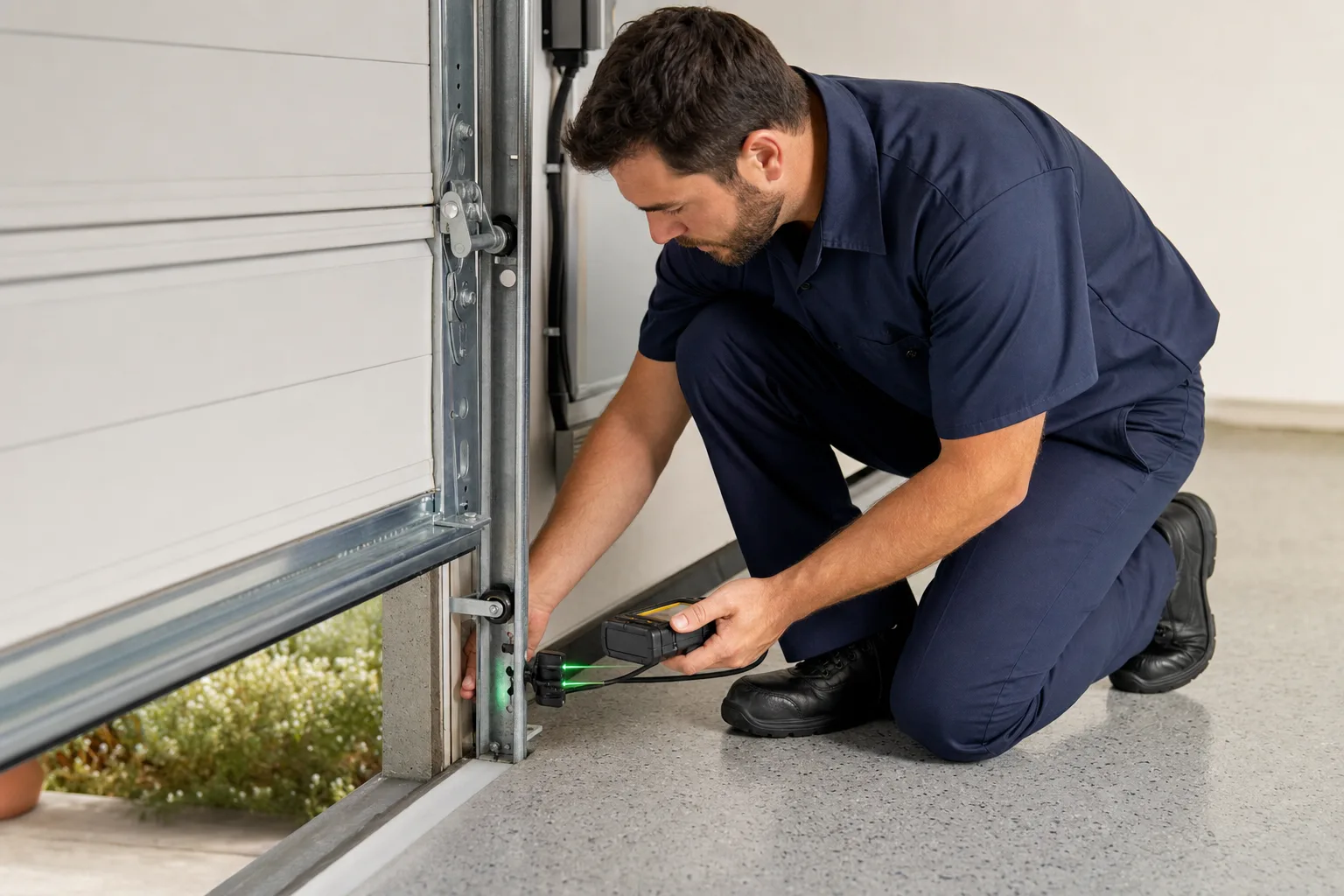
Every opener made since 1993 carries two independent safety systems. The photo-eyes — the small lenses a few inches off the floor on either side of the opening — reverse the door if anything breaks the beam while it is closing. The force limit reverses it if the door meets more resistance than the setting allows.
They leave different fingerprints. A photo-eye reversal is instant: the door starts down, then immediately returns, usually while the opener light flashes. A force reversal happens mid-travel: the door gets partway, touches resistance, and comes back. Which one you have tells you where to look.
Photo-eyes: the usual suspect
The eyes must see each other precisely, and they live in the worst spot in the garage for that — ankle height, where bikes, bins, and brooms live. A nudge that rotates one eye a few degrees is enough. Most units have indicator lights: steady means aligned, blinking means not, and re-aiming the bracket until the light steadies is the whole fix.
The maddening version is intermittent: a door that closes fine all morning and refuses all afternoon. That is usually sun glare — low light striking straight into one lens at a particular time of day and washing out the beam. A small shade over the lens, or angling the sensor slightly, ends it.
Cobwebs and film on the lenses do the same thing more slowly. Wiping both lenses is a legitimate first response to any reversal.
Force limits: drift and friction
The force limit is a threshold: how much resistance the opener will push through before deciding it has hit something. The setting does not change on its own — the door does. Rollers wear, hinges dry out, track shifts a few millimeters, spring balance sags, and friction climbs until an ordinary close crosses the threshold.
Which is why the tempting fix is the wrong one. Turning the force up makes the symptom disappear by making the opener push harder through everything — including a person or a pet. The correct order is to remove the friction — balance, rollers, lubrication, alignment — set the force back to the minimum that runs the door, and then prove it: the door must reverse off a board laid flat on the floor.
When it is neither
A door that genuinely binds — a bent track section, a failing spring leaving it out of balance, a cable pulling one side — will trip a correctly set force limit, and it should. If a reversal keeps returning after the sensors are aligned and the force is properly set, the mechanical cause is still there and it is moving. That is the point where adjustment stops and repair starts.
Rarely, the logic board itself is the fault — reversals with no pattern, on a door that runs freely by hand. It is the last thing we conclude, after everything cheaper has been ruled out, because that is the honest order to rule things out in.
Why does my door only reverse on sunny afternoons?
Sun glare into one photo-eye. When the sun drops low enough to strike the lens directly, it washes out the beam and the opener reads it as an obstruction. A sensor shade or a slight turn of the bracket fixes it permanently.
Is it OK to hold the wall button to force the door closed?
Yes — press-and-hold is a built-in override that closes the door under constant pressure while bypassing the photo-eyes. It is fine as a workaround if you watch the door all the way down. It is not fine as a routine, because it means living without the safety system instead of spending five minutes re-aiming a sensor.
Where should the force limit be set?
As low as reliably runs the door — no lower, no higher. The test is the one the standard requires: a board about an inch and a half thick laid flat under the door, and the door must reverse when it touches it. If it pushes or stalls instead, the force is too high or the door has a friction problem the setting is hiding.
Keep reading
More from the blog.
Why we replace both springs
Springs are rated in cycles and installed as a pair. Replacing one guarantees a second call.
Read the postIs your opener actually broken?
Pull the release and lift the door by hand. What happens next tells you where the fault really is.
Read the postAll garage door services
What we do, what it costs, and how each visit actually goes.
Browse servicesNeed Help With Your Garage Door?
Whether it’s a broken spring, off-track door, faulty opener, or anything in between, our 15+ years of experience allows us to pinpoint the problem fast—offering honest solutions and upfront pricing every time.